
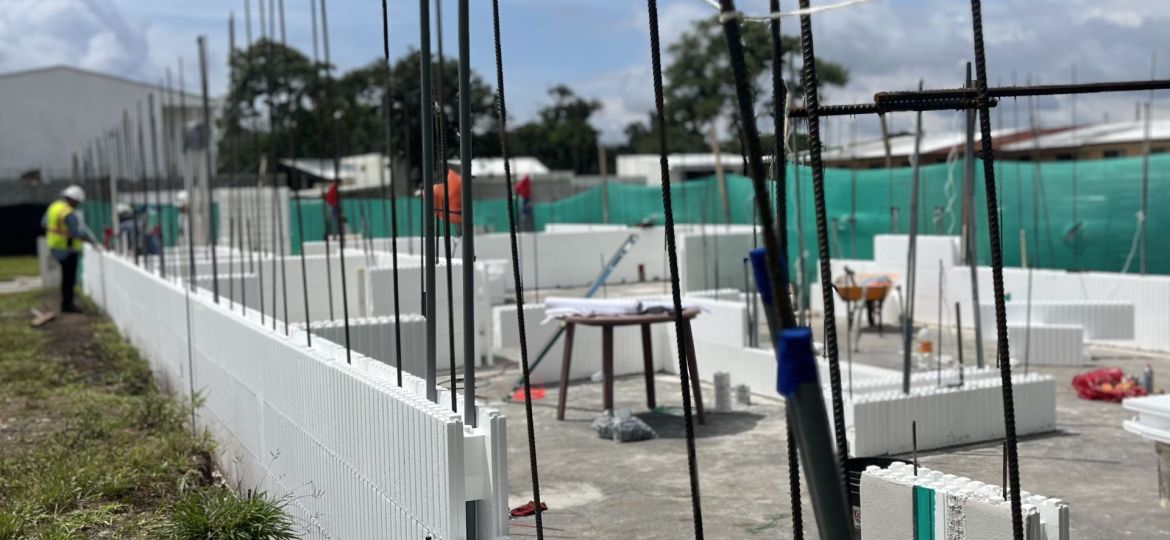
When designing and building your dream home, many factors come into play: aesthetics, energy efficiency, comfort, and increasingly, sustainability. But often, one critical element is overlooked until it’s too late: fire safety.
At OKO HAUSEN, we believe that true peace of mind comes from knowing your home is not just beautiful and efficient, but also exceptionally safe. That’s why we champion Insulated Concrete Forms (ICF) as the foundational system for our sustainable and intelligent homes in Costa Rica. While ICF is renowned for its energy savings and structural resilience, its superior fire resistance is a benefit that truly sets it apart.
The Unseen Danger: Traditional Construction and Fire
Traditional wood-framed homes, while common, inherently present significant vulnerabilities to fire. Wood is a combustible material that fuels flames, allowing fires to spread rapidly. Even with modern building codes, the structural integrity of a wood frame can be compromised in minutes, posing immediate threats to occupants and emergency responders. Concrete block or hollow masonry offers some improvement but still lacks the continuous thermal protection of ICF.
ICF: A Fire-Resistant Powerhouse
ICF construction significantly elevates fire safety standards. Here’s why a home built with ICF is truly a fire-resistant fortress:
- Non-Combustible Core: At the heart of every ICF wall is a solid, steel-reinforced concrete core. Concrete is a non-combustible material; it does not burn or contribute to the spread of flames. Unlike wood, concrete won’t ignite, char, or weaken rapidly when exposed to high temperatures.
- Exceptional Fire Ratings: ICF walls consistently achieve fire resistance ratings that far exceed those of conventional construction. While typical wood-frame walls might offer a 30-minute to 1-hour fire rating, ICF walls can achieve 2-hour, 3-hour, and even 4-hour fire resistance ratings. This means an ICF wall can withstand direct flame exposure for significantly longer periods before structural integrity is compromised or fire penetrates to the other side. This extended time is invaluable.
- Containment and Slowed Spread: The robust nature of ICF walls acts as a formidable barrier, helping to contain a fire to its origin point. By slowing the spread of flames and extreme heat, ICF gives occupants crucial extra time to evacuate safely and allows emergency services more time to arrive and control the blaze before it escalates.
- Minimizing Toxic Fumes: While the expanded polystyrene (EPS) foam in ICF forms is combustible, it is typically treated with fire retardants and is encased by concrete. More importantly, the primary danger in building fires often comes from the toxic gases released by burning materials. Since the concrete core of ICF doesn’t burn, it minimizes the release of these harmful fumes from the structure itself, contributing to a safer environment for those inside.
- Structural Integrity After a Fire: In unfortunate events where a fire does occur, ICF homes tend to maintain their structural integrity better than traditional homes. This can mean less structural damage, potentially lower repair costs, and a faster path to recovery for homeowners.
Peace of Mind with OKO HAUSEN
Choosing an OKO HAUSEN home means investing in a structure built not just for beauty and efficiency, but for unparalleled safety. Our commitment to ICF construction ensures that your family and your cherished assets are protected by walls designed to withstand some of the most destructive forces, including fire.
In a world where natural events and unforeseen accidents can happen, building with foresight is paramount. With an ICF home by OKO HAUSEN, you’re not just building a house; you’re building a secure, resilient sanctuary that offers true peace of mind.